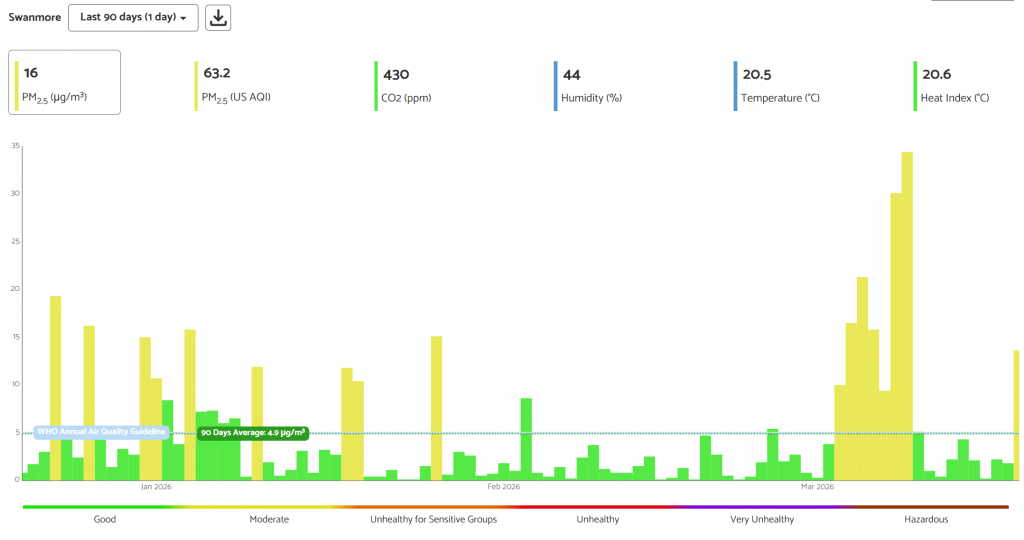
Swanmore air quality had already breached the WHO annual air quality guideline by the 26th January this year.
It’s tempting to think that because we live in a rural community, the air we breathe is healthy and fresh.
The WHO air quality guideline (AQG) states that annual average concentrations of PM2.5 should not exceed 5 µg/m3, while 24-hour average exposures should not exceed 15 µg/m3 more than 3 – 4 days per year.
The Swanmore air quality monitor, set up by SWaCS last year, has already seen the 24-hour average breached 10 days so far in 2026, with the 90-day average currently running at 4.9 µg/m3 – only a fraction below the annual guideline.
While our air quality here in the village is sometimes affected by things out of our control, such as big ships docked in Southampton or Portsmouth and pollution coming in from mainland Europe, some of the pollution is generated much closer to home.
Wood-burning stoves are now recognised as a significant contributor to air pollution in the UK, particularly through the release of fine particulate matter (PM2.5), which can penetrate deep into the lungs and bloodstream.
Despite being used by a minority of households, domestic wood burning is responsible for a large share of these emissions—around 20–38% of PM2.5 in some estimates—making it one of the biggest sources of this harmful pollutant nationally .
Studies show that using a wood burner can temporarily increase indoor particle levels by up to three times, while also emitting gases such as carbon monoxide and nitrogen dioxide .
This pollution has been linked to serious health effects including asthma, heart disease, and premature death, with particularly strong impacts during colder months when stove use is highest.
Although newer “Ecodesign” stoves are cleaner than older models, evidence suggests that even modern wood burners still produce far more particulate pollution than cleaner heating systems like gas or electric heating. As a result, the growing popularity of wood-burning stoves—often for aesthetic rather than essential heating reasons—is increasingly seen as a challenge to improving UK air quality.
View the current air quality in Swanmore.